
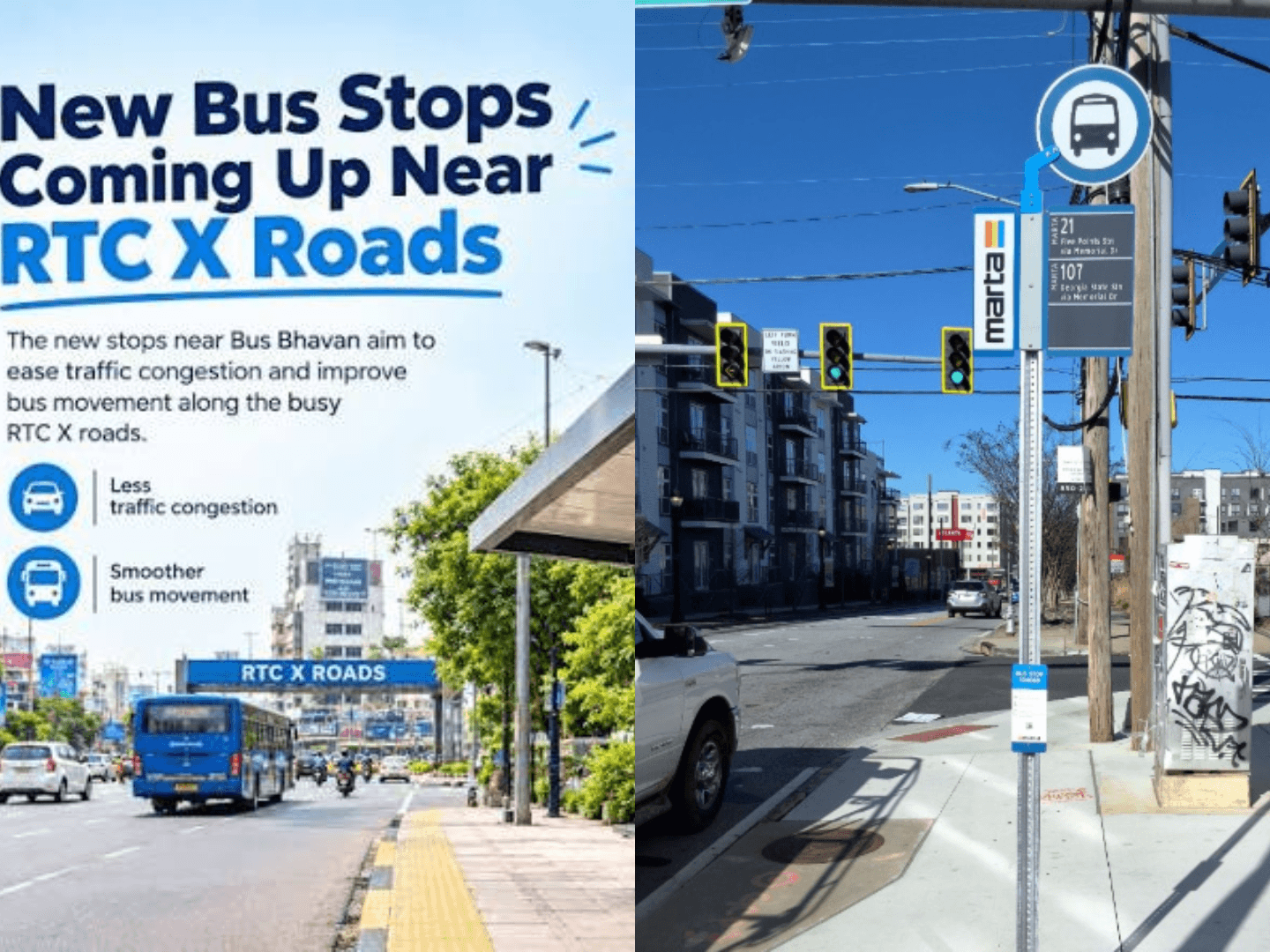
The phrase “near bus stop” carries real legal weight in some places and almost none in others, depending on whether you are standing on a curb or scrolling through a rental listing. In Australia, drivers face specific distance rules around bus stops, while in transit planning the term describes a stop’s position relative to an intersection. Understanding which meaning applies to your situation prevents fines, informs better planning, and helps renters read between the lines of property advertisements.
The most concrete application of “near bus stop” appears in traffic law across several Australian jurisdictions. In New South Wales, the Road Rules 2014 prohibit a driver from stopping within 20 metres before a bus stop sign and 10 metres after it, unless a parking control sign specifically permits stopping there. The maximum penalty is 20 penalty units, and the infringement notice fine currently sits at 330 dollars. These distances are measured in the direction the driver is travelling, meaning the restricted zone extends along the approach to the stop and just past it.
The same 20 metre before and 10 metre after formula appears in the Australian Road Rules framework that predates the current NSW legislation, indicating a consistent regulatory approach across decades. This is not a suggestion or a guideline. It is a substantive offence classified as a parking violation, and enforcement falls under the Self-Enforcing Infringement Notice Scheme. Drivers who stop in this zone, even briefly to drop off a passenger, risk a fine unless a public bus is the vehicle in question and is engaged in regular service.
In New Zealand, the rule operates differently. The Land Transport (Road User) Rule addresses parking near bus stops, and amendments in 2009 specifically clarified provisions relating to parking contrary to markings near bus stops. The distances and specific prohibitions are governed by the Rule rather than a single universal measurement, and drivers in New Zealand should consult the current Land Transport Rule rather than assuming Australian distances apply. This jurisdictional variation matters for anyone travelling or relocating between countries.
Beyond the legal definition, “near bus stop” functions as a technical term in transit engineering. A near-side bus stop is positioned on the approach to an intersection, just before the crossing point, while a far-side stop sits after the intersection. Research published in Transportation Research Record examined how these placements affect bus travel time and determined that near-side stops can reduce delay in certain conditions, particularly when reserved bus lanes are present. However, the same research found that near-side placement more often increases delay compared to a stop located away from the intersection entirely.
| Field | Information |
|---|---|
| Full name | Not applicable (not a person) |
| Also known as | Near-side bus stop (transit term); bus stop parking restriction (legal term) |
| Age | Not applicable |
| Birthplace | Not applicable |
| Nationality | Not applicable |
| Profession | Not applicable |
| Height | Not applicable |
| Education | Not applicable |
| Years active | Legal rule in force in NSW since 2014; NZ rule amended 2009 |
| Notable works | Road Rules 2014 rule 195 (NSW); Land Transport (Road User) Rule 2004 clause 6.8 (NZ) |
| Awards | Not applicable |
| Net worth | Not applicable |
| Spouse or partner | Not applicable |
| Social media | Not applicable |
Verified facts included above: the NSW rule is Road Rules 2014 rule 195, prohibiting stopping within 20 metres before and 10 metres after a bus stop sign, with a maximum penalty of 20 penalty units and an infringement fine of 330 dollars . The New Zealand rule is clause 6.8 of the Land Transport (Road User) Rule 2004, prohibiting stopping within 6 metres of a bus stop sign, substituted in November 2009 .
A 2013 study published in the Journal of the Eastern Asia Society for Transportation Studies used microscopic traffic simulation to compare near-side and far-side bus stop performance in Seoul, Korea. The results revealed that a near-side stop performs better under ordinary signal control conditions, but a far-side stop improves more dramatically when a Bus Priority Signal System is adopted, achieving a 13.3 percent average reduction and a 22.2 percent range reduction in bus travel times under congested demand. These findings give transit planners a framework for choosing stop locations based on traffic conditions and signal technology rather than intuition.
The phrase also appears in the rental market, where “near bus stop” serves as a selling point in property listings from Dubai to Singapore to Albuquerque. A Dubai listing for a one-bedroom apartment in Al Nahda explicitly advertises proximity to RTA bus routes F22 and F24 as part of its appeal. A Singapore condominium listing for Melville Park highlights a two-minute walk to bus services including 9, 12, and 38. These listings treat bus stop proximity as an unambiguous benefit, but the academic evidence on whether it actually raises property values is more complicated.
Research on transit accessibility and apartment rents has produced mixed findings. A 2008 study by Xinyu Cao and Jill Hough published in the Journal of the Transportation Research Forum examined roughly 400 apartment dwellers in Fargo, North Dakota, and found a negative impact of bus transit on apartment rent after controlling for other factors. The authors speculated that in a small urban area, this negative relationship could stem from nuisance effects of bus transit itself or spurious relationships from other causal factors. Earlier research cited in the same study found that bus stop density was negatively associated with apartment rents in Austin, Texas, with researchers pointing to bus noise and the concentration of bus services in lower-income neighborhoods as possible explanations.
These findings do not mean bus stops make apartments undesirable. They suggest that proximity to transit operates differently for renters than for homeowners, and that the effect varies by city size, neighborhood income level, and the quality of the transit service itself. A listing that emphasizes “near bus stop” is appealing to a renter without a car, but it may not command a premium in the way that proximity to a rail station sometimes does. The academic literature on bus transit and property values remains thinner than the research on rail, and the results resist simple generalization.
For anyone encountering the phrase, the first question is context. A driver in Sydney needs to know the 20 metre and 10 metre rule and the 330 dollar fine. A transit planner in Seoul or elsewhere needs to weigh near-side versus far-side placement against signal systems, congestion levels, and passenger boarding patterns. A renter in Dubai or Singapore can treat the phrase as a convenience signal but should verify the actual walking distance and service frequency rather than assuming the label guarantees good transit. The phrase itself is short, but the obligations, engineering tradeoffs, and market signals behind it are not.
Q1: Can I stop my car within 20 metres before a bus stop sign in New South Wales?
No. Under Road Rules 2014 rule 195, a driver other than a public bus driver must not stop within 20 metres before or 10 metres after a bus stop sign, unless a parking control sign specifically permits it . The maximum court penalty is 20 penalty units, and the current infringement notice fine is 330 dollars . Stopping in a school zone near a bus stop carries a higher fine of 387 dollars and 2 demerit points .
Q2: How does the bus stop parking rule in New Zealand differ from Australia?
New Zealand uses a much shorter distance. The Land Transport (Road User) Rule 2004 clause 6.8 prohibits stopping, standing, or parking within 6 metres of a bus stop sign . This rule was substituted in November 2009. Unlike the Australian 20/10 metre formula, New Zealand applies a single 6 metre restriction, though the prohibited area can be marked longer or shorter under clause 6.15 .
Q3: What is a “near-side” bus stop in transit planning?
A near-side bus stop is positioned on the approach to an intersection, just before the crossing point. The New York State Department of Transportation design manual advises that near-side turnouts should be avoided where right turns are allowed because they conflict with right-turning vehicles and obstruct traffic control devices . Far-side stops are generally preferred at signalised intersections because the signal can create gaps for buses to re-enter traffic .
Q4: Does the 20 metre rule apply everywhere in Australia?
No. The 20 metres before and 10 metres after rule is specific to New South Wales under Road Rules 2014 . While the Australian Road Rules provide a national framework, individual states and territories adopt and modify these rules. Drivers in other jurisdictions should check their local road rules rather than assuming the NSW distances apply. The NSW rule also contains a subrule specifically addressing public bus drivers picking up or dropping off passengers .
Q5: What happens if a vehicle is illegally parked in a bus zone in NSW?
Since June 2022, bus zones in NSW have been classified as a “prescribed place” for tow-away provisions under the Road Transport (General) Regulation 2021 . Transport for NSW reported 564 incidents of vehicles parked in bus stops in the 12 months to July 2021 . Tara McCarthy, Deputy Secretary of Safety, Environment and Regulation at Transport for NSW, stated that the changes improve passenger safety, especially for those with mobility issues, children, the elderly, and parents with strollers .
