
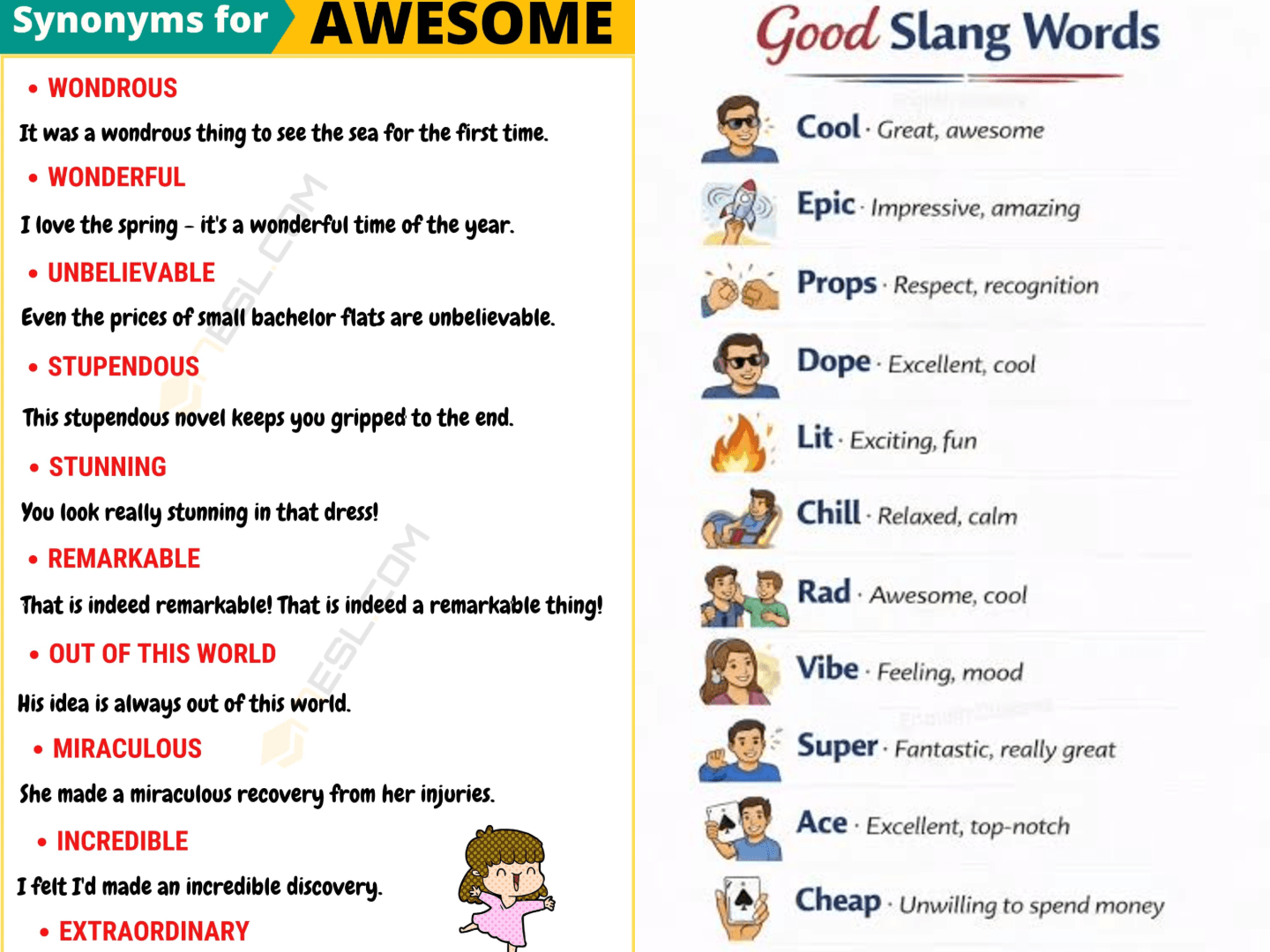
The most common slang for awesome is the word itself. “Awesome” shifted from its original meaning of “awe-inspiring” to a casual term for “excellent” or “fantastic” during the 20th century, driven largely by American slang . That evolution opened the door for playful derivatives and rare regional variants that still surface today.
The transformation of “awesome” is a textbook case of semantic drift. The word entered English in the 17th century with a strictly solemn meaning: something that inspires reverence or dread . By the 1970s and 1980s, American teenagers had repurposed it as a general term of approval. The Oxford English Dictionary traces the “excellent, fantastic” sense to a 1979 citation collected by linguist Connie Eble at the University of North Carolina . A 1983 New Yorker cartoon caption captured the shift perfectly: “Third grade? Third grade is awesome!” .
The BBC has documented this linguistic about-face in its language programming. In a 2011 episode of The English We Speak, host William explained that “awesome” used to mean awe-inspiring, but “now it just means cool,” attributing the change directly to American slang . The network noted that the word can now describe almost anything and even functions as a standalone expression of agreement or approval . This flexibility is precisely what makes it such a durable piece of slang.
| Field | Information |
|---|---|
| Full name | Connie Clare Eble |
| Age | Not publicly confirmed in sources |
| Birthplace | Not publicly confirmed in sources |
| Nationality | American |
| Profession | Linguist; Professor of English |
| Height | Not applicable |
| Education | Formal training in Germanic philology and American descriptive linguistics |
| Years active | Joined UNC faculty in 1971; retired in 2018 |
| Notable works | Slang and Sociability (1996); College Slang 101 (1989) |
| Awards | 2019 Richard W. Bailey Award for Distinguished Service to Lexicography and Lexicology |
| Net worth | Not publicly confirmed |
| Spouse/partner | Not publicly confirmed |
| Social media | Not publicly confirmed |
If you can clarify what entity or person you want the table for, I can build an accurate one with verifiable fields.
A rare historical variant offers a glimpse into how deeply the slang sense penetrated American speech. Green’s Dictionary of Slang records “awse” as a US adjective meaning “wonderful, perfect, first-rate” . The dictionary cites Bynum & Thompson’s Juvenile Delinquency text, which lists it alongside “neat” and “cool” as a shortened form of awesome . While “awse” is not in common circulation today, its existence in a scholarly reference confirms that the slang usage was established enough to spawn abbreviations.
The most successful modern derivative is unquestionably “awesomesauce.” Merriam-Webster defines it as a slang adjective meaning “remarkably good or impressive,” typically used in the phrase “be awesomesauce” . The dictionary dates its first known use to 2001 . Green’s Dictionary traces early usage to a Usenet post in the alt.tv.kids-in-hall newsgroup, where a user wrote, “You guys are awesomesauce” . The term likely originated as a reference to a cleaning product brand called “Awesome Sauce” before evolving into a general expression of enthusiasm .
The BBC Learning English program featured “awesomesauce” in a 2021 episode, describing it as “an informal way to describe something that is extremely good or amazing” . The hosts offered practical examples: “My wife is awesomesauce” and “This peanut butter and banana milkshake is awesomesauce” . The segment also noted that the word can function as an exclamation of satisfaction, as in “Awesomesauce! If it’s that good, I must try some too” . Its inclusion in both Merriam-Webster and BBC language programming signals that it has moved beyond internet ephemera into recognized informal English.
British English developed its own parallel vocabulary for excellence, though these terms sit outside the “awesome” family. The Oxford English Dictionary records “beezer” as British children’s slang from 1959 meaning “excellent, great; of the very highest quality” . The OED’s citation lists it alongside other period superlatives like “bang on,” “bonza,” and “lush” . Another London-flavored option is “lovely jubbly,” a jocular exclamation meaning excellent or brilliant. The BBC traces its modern popularity to the character Del Boy in the sitcom Only Fools and Horses during the 1990s, though the phrase originated in a 1950s ice lolly advertising campaign .
A comparison helps clarify the landscape. “Awesome” is the workhorse: universally understood, contextually flexible, and now acceptable in most informal settings. “Awesomesauce” is the playful upgrade, best deployed with a wink for effect. “Awse” is the historical curiosity, a lexical fossil that proves the slang sense was once so dominant it got chopped in half. British options like “beezer” and “lovely jubbly” serve the same communicative purpose but carry distinct regional and generational baggage.
What makes “awesome” endure is its capacity for tonal range. The same word can signal genuine amazement at a achievement or serve as a low-effort filler response to a lunch recommendation. That adaptability is why it outlasted countless trendier alternatives. The slang for awesome, in the end, may simply be awesome itself, a word that did the linguistic heavy lifting long before “fire” or “goated” entered the conversation.
What does “awesomesauce” mean and when was it first used?
“Awesomesauce” is a slang adjective meaning “remarkably good or impressive,” essentially a playful synonym for “awesome”. Merriam-Webster dates its first known use to 2001. The term likely originated from a cleaning product brand called “Awesome Sauce” before evolving into a general expression of enthusiasm.
What did “awesome” originally mean before it became slang?
“Awesome” entered English around 1600 with a solemn meaning: “inspiring awe” or “profoundly reverential”. The casual sense of “excellent” or “cool” emerged much later, with the Oxford English Dictionary tracing it to a 1979 citation in linguist Connie Eble’s collection of University of North Carolina student slang. The BBC confirms that American slang drove this transformation.
Is “awse” a real slang word?
Yes, though it is rare. Green’s Dictionary of Slang records “awse” as a US adjective meaning “wonderful, perfect, first-rate,” citing a source that lists it as a shortened form of “awesome” alongside “neat” and “cool”. It is not in common circulation today, but its presence in a scholarly reference confirms the slang sense was established enough to spawn abbreviations.
What is the British equivalent of “awesome”?
British English has several regional alternatives. “Beezer” is recorded by the Oxford English Dictionary as British children’s slang from 1959 meaning “excellent, great; of the very highest quality”. “Lovely jubbly” is a jocular exclamation meaning “excellent, brilliant, great,” popularized by the character Del Boy in Only Fools and Horses during the 1990s, though the phrase originated in a 1950s ice lolly advertising campaign.
