
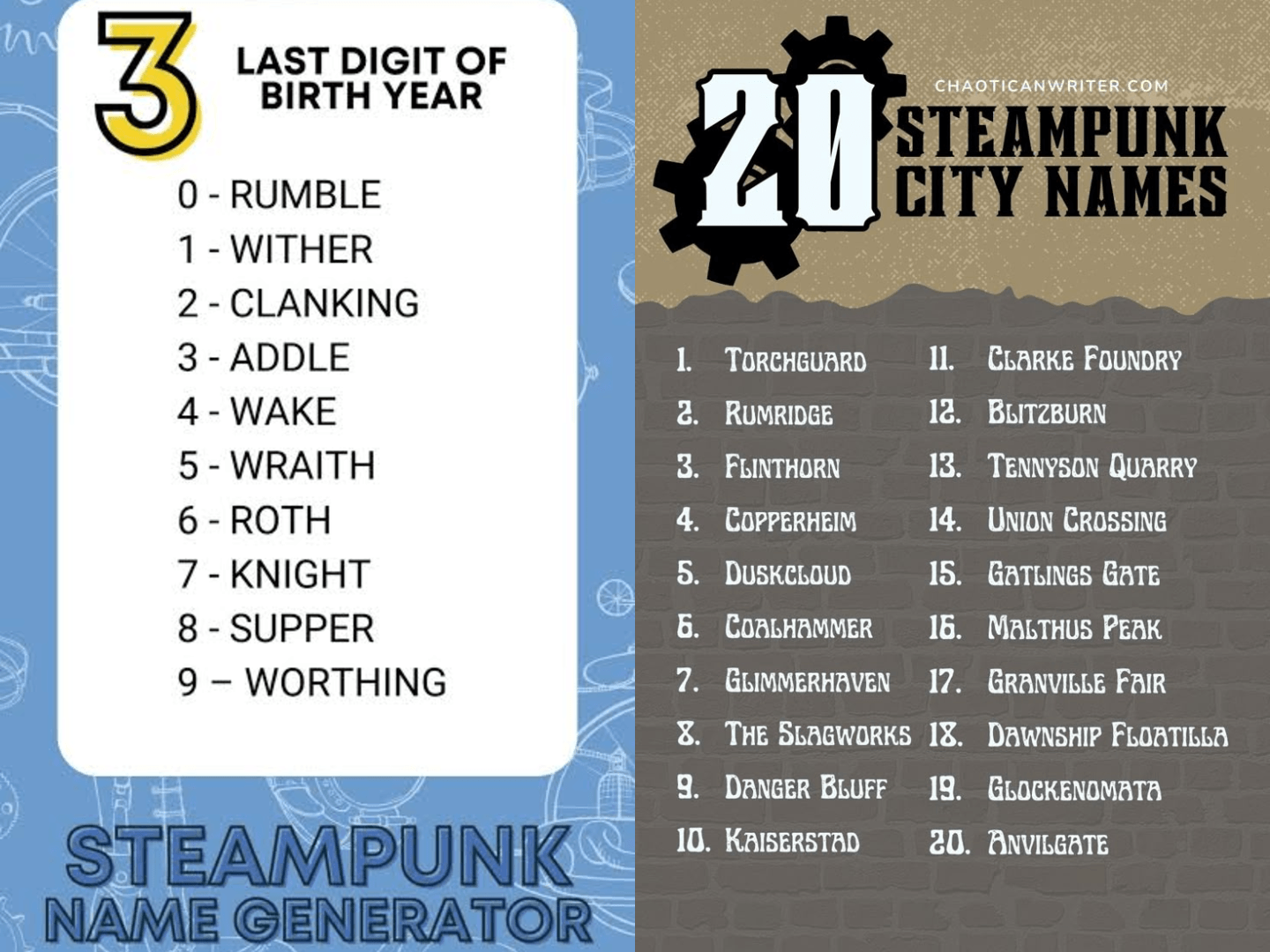
A steampunk name generator is a free online tool that produces Victorian-era character names for writers, tabletop role-playing gamers, and cosplayers building personas in the genre. It works by pairing authentic 19th-century first names with invented surnames that reference steam-age trades and machinery.
The steampunk name generator exists because naming characters in this genre requires balancing historical authenticity with mechanical invention. The genre itself has roots that extend back decades. Author K.W. Jeter coined the term in 1987 to describe a wave of speculative fiction set in alternate Victorian eras, and William Gibson and Bruce Sterling brought it to a wider audience with their 1990 novel The Difference Engine, which imagined a Victorian England powered by Charles Babbage’s mechanical computing engines .
Most generators operate on a straightforward principle. They combine given names drawn from the Victorian period with surnames that evoke the tools, materials, and trades of a steam-powered world. Some tools let users filter by gender, social class, or character archetype, such as inventor or aristocrat. Others present results as three-part names, following the formal Victorian tradition of two given names plus a surname .
The Victorian era, which lasted from 1837 to 1901 during the reign of Queen Victoria, provides the historical foundation for these names . Biblical names for boys were extremely popular, from Abraham and Amos to Jeremiah and Job . German-influenced names like Albert, Bertram, and Herbert also ranked highly, reflecting the influence of Prince Albert and the royal princes . For girls, the names Queen Victoria chose for her daughters, including Helena, Louise, and Beatrice, saw sharp rises in popularity following the princesses’ births .
What distinguishes steampunk names from ordinary Victorian names is the surname tradition. English surnames historically described what people did, with names like Smith, Wright, Cooper, and Mason serving as literal occupational markers . Steampunk generators extend this pattern by substituting industrial roots for traditional ones while preserving the familiar suffixes. The result is names like Gearwright, Brasswick, and Steamworth, which feel authentic because they follow real English naming conventions .
The “punk” element matters as much as the Victorian foundation. Steampunk is not merely Victorian cosplay; it involves subversion of the era’s rigid social structures. Names often pair proper Victorian formality with something unexpected, such as a titled aristocrat who works as a sky pirate or a street urchin bearing an impossibly grand name . This tension between propriety and rebellion is what gives the genre its distinctive flavor.Quick Bio: Thomas Willeford (Lord Archibald “Feathers” Featherstone)
Note: The search results do not contain verified information for Thomas Willeford’s age, birthplace, nationality, awards, net worth, spouse, or social media accounts. I have not included those fields to avoid presenting unverified information.
Different generators serve different purposes. Some are designed specifically for tabletop role-playing games like GURPS Steampunk, allowing game masters to generate non-player characters quickly . Others target fiction writers who need to populate a novel with period-appropriate names. The persona created for steampunk subculture participation is sometimes called a “steamsona,” a term documented in The Steampunk Bible and derived from the combination of “steam” and “persona” .
Social class plays a visible role in steampunk naming. Upper-class Victorians had long, elaborate names with multiple given names and hyphenated surnames, while working-class names were short and practical . A steampunk generator may reflect this hierarchy by offering different naming styles, from aristocratic names dripping with inherited privilege to gutter nicknames earned through skill or habit.
The genre’s cultural footprint has expanded significantly since its literary origins. Steampunk Magazine declared in its inaugural issue that practitioners were “colonizing the past so we can dream the future,” a statement that captures the genre’s blend of nostalgia and technological imagination . Conventions, fashion lines, and dedicated publications have grown around the aesthetic, and the demand for period-appropriate names has grown alongside them.
For writers and gamers, the practical value of a steampunk name generator lies in speed. Generating a name takes seconds, whereas researching Victorian census records or surname dictionaries could consume hours. The tool serves as a starting point rather than a final answer, allowing users to generate multiple options and refine their selections manually. The best results come from treating the generator as a creative collaborator, not a replacement for judgment about what fits a specific character.
What exactly does a steampunk name generator do?
It combines authentic Victorian-era first names with invented surnames that reference industrial trades and machinery. The tool produces character names for writers, tabletop role-playing gamers, and cosplayers. Most generators let users filter by gender, social class, or archetype such as inventor or aristocrat.
Are steampunk names historically accurate?
They draw on real Victorian naming conventions. First names reflect the era’s popular choices, and English surnames historically described occupations, including Smith, Wright, and Cooper . Steampunk generators extend that tradition with industrial roots while preserving familiar suffixes like -wright and -smith.
Who uses these generators?
Fiction writers populate novels with period-appropriate names. Game masters generate non-player characters for systems like GURPS Steampunk . LARPers and cosplayers build personas called “steamsonas,” a term documented in The Steampunk Bible . One notable example is maker Thomas Willeford, whose steamsona is Lord Archibald “Feathers” Featherstone .
Can I use generated names in my novel or game?
Yes. The names are original combinations produced by the tool and are not subject to copyright restrictions. Most generators exist as free creative aids without licensing requirements. As with any character name, checking for unintended meanings or awkward combinations before publication is always wise.
