
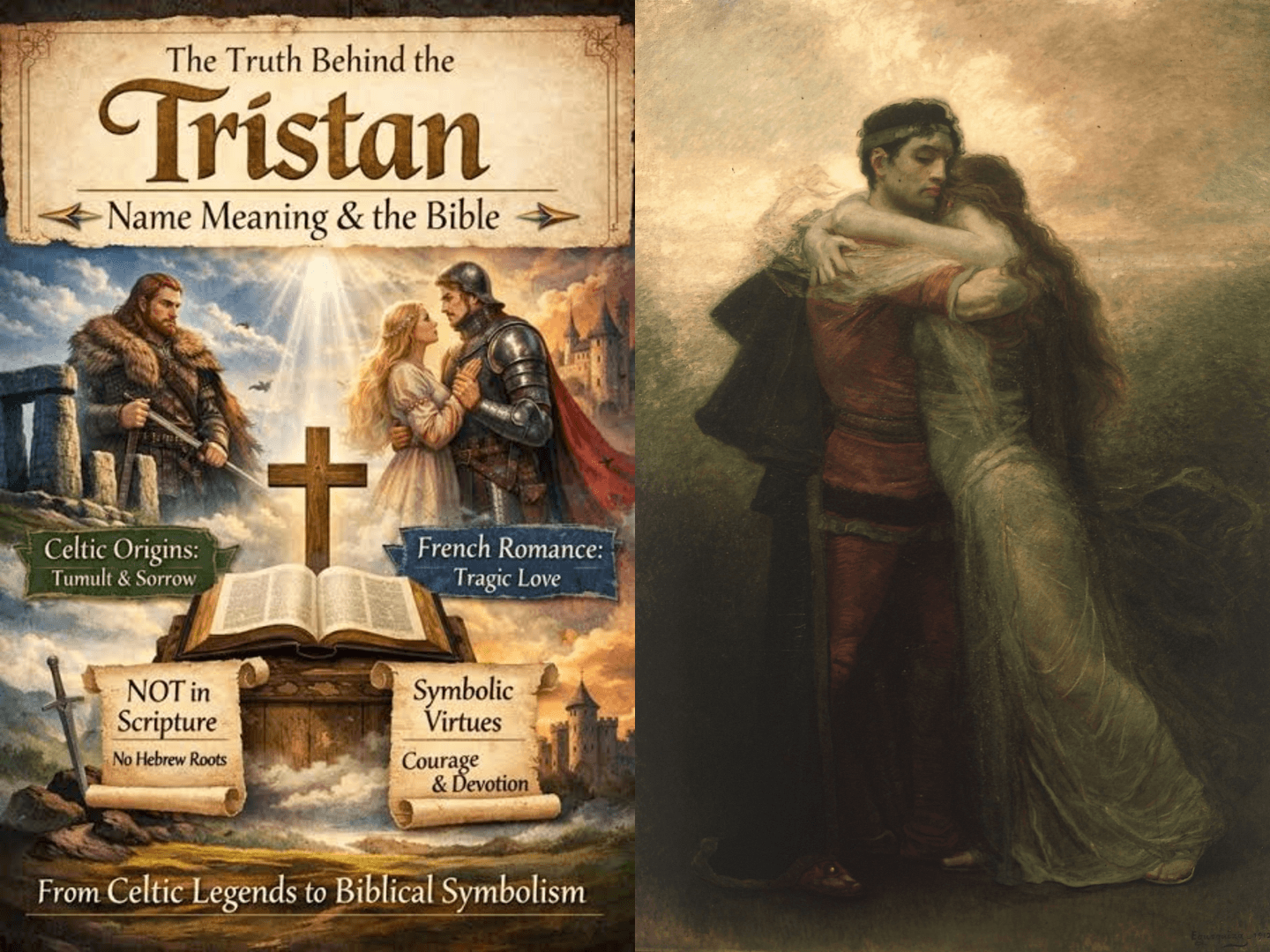
Tristan is not a name found anywhere in the Bible. It appears in no book of the Old or New Testament, in no standard English translation, and belongs to no biblical figure. The name instead comes from Celtic tradition and medieval romance, specifically the legend of Tristan and Iseult . Any connection between Tristan in the Bible is thematic or symbolic, not textual.
Where the Name Tristan Actually Comes From
The name Tristan derives from Welsh and Old Brythonic roots, likely from drust meaning “noise” or “tumult” . Its later association with sadness comes from the French word triste, which influenced how medieval writers understood the character . The name’s popularity owes almost entirely to literature, not Scripture.
The legend of Tristan and Iseult emerged in French literature during the twelfth century and survives in multiple medieval versions . The most famous medieval treatment was the Anglo-Norman poem by Thomas, though only fragments remain. The story was reconstructed from later texts, including Gottfried von Strassburg’s Middle High German Tristan and Brother Robert’s Old Norse Tristrams saga . The tale is Celtic in origin and centers on a Cornish knight, not a Hebrew patriarch or Christian saint.
Why People Search for Tristan in the Bible
The confusion likely stems from two sources. First, the name’s popular association with sorrow leads some to connect it with biblical themes of suffering, particularly Isaiah 53:3, which describes the Messiah as “a man of sorrows, acquainted with grief” . That verse says nothing about Tristan, but the emotional overlap creates a surface-level link.
Second, the medieval Tristan legend itself contains narrative motifs that echo biblical stories. Scholars have noted parallels between Tristan’s sea voyage and the book of Jonah, and between Isolde’s trial by ordeal and the biblical “Waters of Bitterness” test in Numbers 5 . A substitution-bride episode in the legend also resembles the Jacob and Leah story in Genesis . These are literary borrowings or coincidences, not evidence that Tristan belongs in Scripture.
What the Bible Actually Says About Names
Biblical names carry meaning with far more consistency than Tristan’s later symbolism. Isaac means “he laughs,” reflecting Sarah’s laughter at the promise of his birth . Jesus, from the Hebrew Yeshua, means “The Lord is salvation,” and the angel explicitly instructs Joseph to give the child that name . Peter receives his name from the Greek word for rock, signifying his foundational role .
The Bible treats naming as a deliberate, often prophetic act. Abram becomes Abraham, “father of many nations,” as part of a covenant . Jacob becomes Israel after wrestling with God . Tristan has no such scriptural naming moment because the name did not exist in the biblical world.
Notes on gaps: Several fields are marked “Not confirmed” because the available search results did not contain authoritative information for those specific data points. NBA contract earnings are presented as verified career salary data rather than speculative “net worth” figures. Social media handles were included only when cited by a reliable source.
How Some Christians Use the Name Today
Some Christian families choose Tristan despite its absence from Scripture, treating the name’s sorrowful associations as a starting point for redemptive themes. The logic runs that God can bring beauty from ashes, a phrase drawn from Isaiah 61:3, and that a name meaning sorrow can serve as a reminder of transformation. This is a personal theological choice, not a biblical claim about the name itself.
The name also carries literary prestige that appeals to parents regardless of religious background. Richard Wagner’s opera Tristan und Isolde, completed in 1865, cemented the name’s association with tragic romance . Brad Pitt’s portrayal of Tristan Ludlow in the 1994 film Legends of the Fall drove a measurable spike in American baby name usage, with variant spellings entering the top 1000 boys’ names by 1995 . The name has remained in the top 1000 in the United States since 1971 .
Common Questions About Tristan and the Bible
Is Tristan a Christian name? It is used by Christians, but that does not make it biblical. Many names used by Christian families, including Grace, Faith, and Christopher, do not appear in Scripture either . The standard for a “Christian name” in practice is broader than biblical origin.
Is there a Saint Tristan? No verifiable saint named Tristan appears in standard hagiographical sources. Claims about medieval saints or crusaders named Tristan circulate online but lack reliable documentation and should be treated with caution.
What does Tristan mean in the Bible? Nothing, because the name is not in the Bible. Its meaning comes from Celtic and French linguistic history, not from Hebrew or Greek Scripture.
The Bottom Line
Tristan in the Bible is a search that leads to a clear negative answer. The name belongs to Arthurian romance, Celtic etymology, and European literature. It has no verse, no genealogical entry, and no prophetic naming scene. Anyone drawn to the name for its sound or its literary history can use it freely, but they should not expect to find it between Genesis and Revelation.
Is the name Tristan in the Bible?
No. The name Tristan does not appear in the Old Testament, the New Testament, or any standard English translation of the Bible. It has no biblical figure, verse, or Hebrew or Greek root. The name comes from Celtic tradition and became famous through the medieval legend of Tristan and Iseult, not through Scripture .
Where does the name Tristan come from?
Tristan derives from Celtic roots, likely from a Pictish name Drostan or the Welsh Drystan, with meanings associated with “tumult” or “noise” . Its later association with sadness comes from the French word triste, which influenced medieval writers. The name’s popularity stems almost entirely from the Tristan and Iseult romance, which emerged in French literature in the twelfth century .
Is there a Saint Tristan?
There is no widely recognized Saint Tristan in standard Catholic hagiography. A sixth-century Scottish abbot named Drostan (or Drustan) is venerated as a saint, and some sources connect the name to him, but he is not the same figure as the legendary Tristan . Claims about other medieval saints named Tristan lack reliable documentation and should be treated with caution.
Why do some people think Tristan is in the Bible?
The confusion likely comes from thematic parallels rather than textual evidence. The name’s popular association with sorrow leads some to connect it with biblical themes of suffering, such as Isaiah 53:3, which describes the Messiah as “a man of sorrows.” Scholars have also noted that the medieval Tristan legend contains narrative motifs echoing biblical stories, including a sea voyage resembling the book of Jonah and a substitution-bride episode similar to the Jacob and Leah story in Genesis . These are literary borrowings or coincidences, not evidence that Tristan belongs in Scripture.
